
How Bench Warrants Work in Marshall County
A bench warrant is a judge's order to bring someone into custody because a duty in an open case went unmet. Marshall County judges issue them for several reasons. Missing a required hearing is the classic one. So is violating a release term, skipping a court-ordered task, or ignoring a directive from the bench. Lawyers and dockets call that trigger a failure to appear, often shortened to FTA. Local records tend to say bench warrant or warrant after failure to appear rather than capias. That wording matters when you read a Marshall County docket, because the chronological case summary, or CCS, shows exactly what the judge ordered and when. An old entry alone, though, will not tell you whether the warrant still stands today. Call the court for the current status.
Marshall County Missed-Court Path
Missing a court date does not create a new public roster in Marshall County. It changes the case you already have. The judge may note the failure, issue a bench warrant, change bond, or schedule a new hearing. Later entries can show service, a return appearance, bond review, or recall. Recall means the court withdraws the warrant. Quash is another word for setting one aside, though local records may phrase it differently.
The useful record is therefore a sequence, not one isolated line: scheduled hearing → failure-to-appear entry → warrant order → service or voluntary appearance → recall or further order. Search the public case only as a lead, then ask the Marshall County Clerk for the current public entry.
The official MyCase screen shows the public case-search shell a reader can use for that first lead in Marshall County. It is still not a warrant database, so treat it as a starting point only.
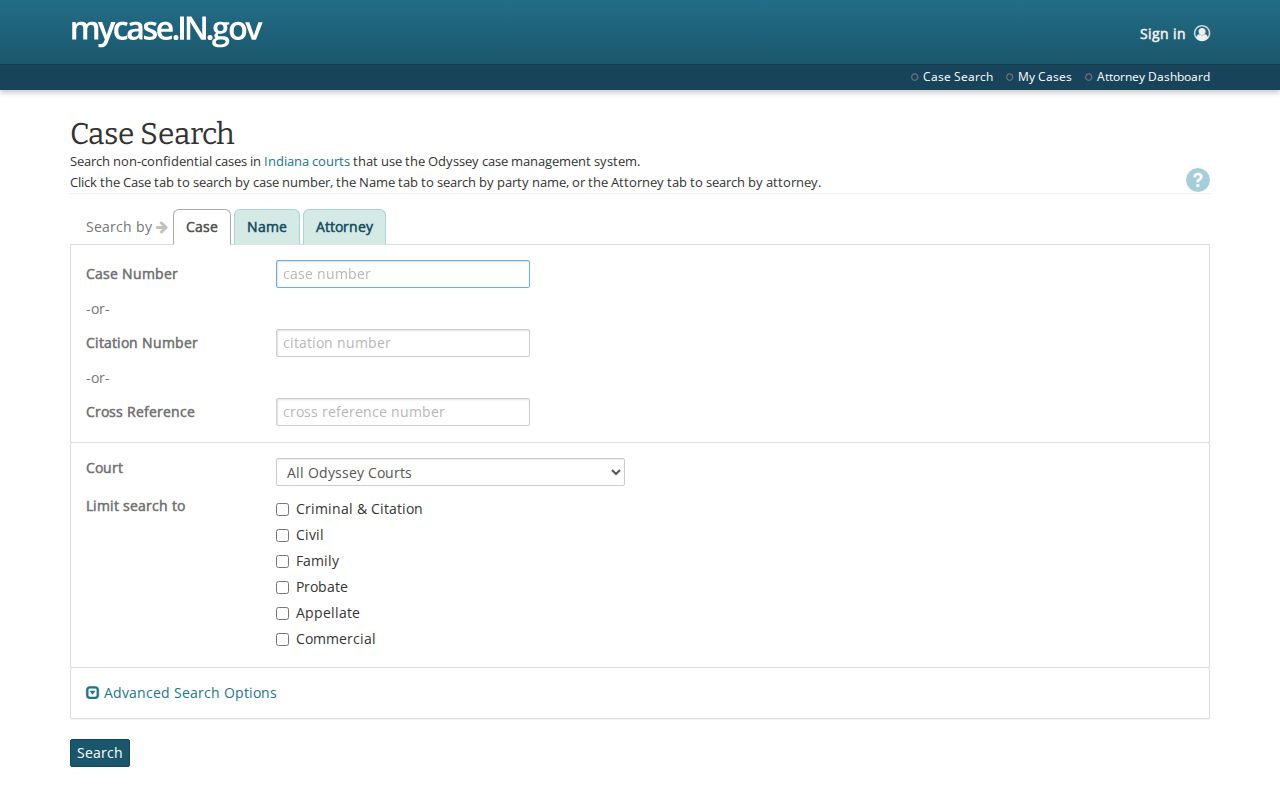
Note: A blank or delayed online docket does not prove that no Marshall County bench warrant exists.
Bench Warrant Issuance in Marshall County
The judge assigned to the underlying case decides whether a bench warrant gets issued in Marshall County. The order lets law enforcement bring the person before the court. It can also set bond or conditions. The sheriff serves warrants and handles custody. He cannot cancel a judge's order. Only the issuing court can recall or modify it. Indiana also has no public statewide warrant search. MyCase may flag a warrant in a public criminal case summary, but the Indiana judiciary states plainly that MyCase is not a warrant lookup. Confidential, sealed, expunged, older, or otherwise unavailable material may not appear. Call the court to confirm.
Reading Marshall FTA Entries
Begin with the cause number. Marshall court identifiers route a Marshall County record to the right place: 50C01 marks Circuit Court, while 50D01, 50D02, and 50D03 mark the three Superior Courts. The county uses no separate local warrant-number format. So never treat a case number as a warrant number.
- CCS
- The chronological case summary, which lists public docket events in date order.
- FTA
- Failure to appear for a required court date.
- Recall
- A court order withdrawing an outstanding warrant.
- Bond forfeiture
- A court action involving bond after a missed obligation; it is not the same as a conviction.
How Bench and Arrest Warrants Differ
Both order types can put a person in custody, but they arise at different stages. For the probable-cause process, see the companion Arrest Warrant Lookup.
| Feature | Bench warrant | Arrest warrant |
|---|---|---|
| Typical trigger | Missed hearing or unmet court duty | Probable cause tied to an alleged offense |
| Case setting | Usually an existing case | May begin or advance a criminal case |
| Key record | CCS and judge's order | Warrant, charge, and available affidavit material |
| Next step | Issuing court addresses recall and appearance | Court addresses surrender, custody, bond, and hearing |
Marshall Bench-Warrant Bond Rules
Marshall local rules include a provisional criminal bond schedule. It is not an automatic quote for every bench warrant. The schedule applies in defined circumstances, when a person is arrested outright and no judicial officer has already set a bond. Judges can review or change any amount, and separate holds or release conditions may also control. Under the local schedule, multiple offenses take the highest applicable bond. The schedule also lists possible enhancements for prior failures to appear, multiple victims, prior felonies, or an alleged offense committed while on probation, parole, bond, or release. Some domestic-violence arrests carry a 24-hour hold and no-contact terms. So ask three questions. Is a bond already set? Is judicial review pending? Does another hold apply in this Marshall County case?
Key point: A posted bond does not dismiss the case or prove that the bench warrant has been recalled.
Clearing a Bench Warrant in Marshall County
Marshall County publishes no official recall form, online quash tool, or guaranteed walk-in docket. Call before you appear. The court may want a hearing, a motion, payment, bond, or proof that the missed duty is now done. An attorney can ask about a voluntary appearance and the safest way forward.
- Confirm the cause number, issuing court, and current public warrant entry.
- Ask the court what appearance, motion, or hearing is required.
- Ask whether bond is set and whether other holds or conditions apply.
- Keep the later CCS entry or order that documents recall or resolution.
Caution: Do not arrive at a court or sheriff lobby based only on an old online entry; confirm current instructions first.
Clerk and Sheriff Roles
The Clerk and the Sheriff answer different questions in Marshall County. The Clerk keeps the court file and helps you locate public orders, charging information, and CCS entries. The Sheriff handles warrant information, service, jail status, and custody. Do not treat the two offices as interchangeable.
Marshall County Clerk
211 W. Madison Street, Plymouth, IN 46563
574-936-8922
Ask for a cause-number-specific public record or current court routing.
Marshall County Sheriff
1400 Pioneer Drive, Plymouth, IN 46563
574-936-3187
Press 2 for Jail & Warrant Information on the published menu.
The Marshall County Sheriff FAQ mentions a lobby kiosk and the GTL Connect Network for eligible bond payments. Confirm the account, method, fee, and eligibility before sending money.
Marshall County Courts That Issue Bench Warrants
Current official sources list the Marshall Circuit Court and Superior Courts Nos. 1, 2, and 3 as the active courts. The former Plymouth City Court and Argos Town Court are abolished. A city police agency may still issue a citation or serve an order. That does not mean a current city court owns the case. For addresses, Circuit Court and Superior Court No. 3 sit at 501 N. Center Street in Plymouth. Superior Courts Nos. 1 and 2 use 211 W. Madison Street. Check the case number to confirm the division before you visit. If the court is unknown, use the countywide Warrant Check route.
Proof a Marshall Warrant Changed
A resolved warrant in Marshall County leaves a paper trail. That trail matters. Ask the clerk for the public order or CCS entry showing a recall, quash, service, new hearing, bond action, or final outcome. The Marshall court copy-request form makes that easy. Fill in a cause number, the document date, what you want, and how many copies. You can arrange mail, email, or pickup, and the office will take a card payment by phone. The published fee is $1 per page and $3 for certification, so confirm current fees before ordering. Name an existing record with reasonable detail. A broad request for every Marshall County warrant may not describe any single record well enough, and Indiana access rules do not force an agency to build a new list. Juvenile, sealed, or confidential material stays off limits, and family ties alone do not change that.